
Nepal Tea: The Himalayan Hidden Gem You Need to Try (Complete Guide)
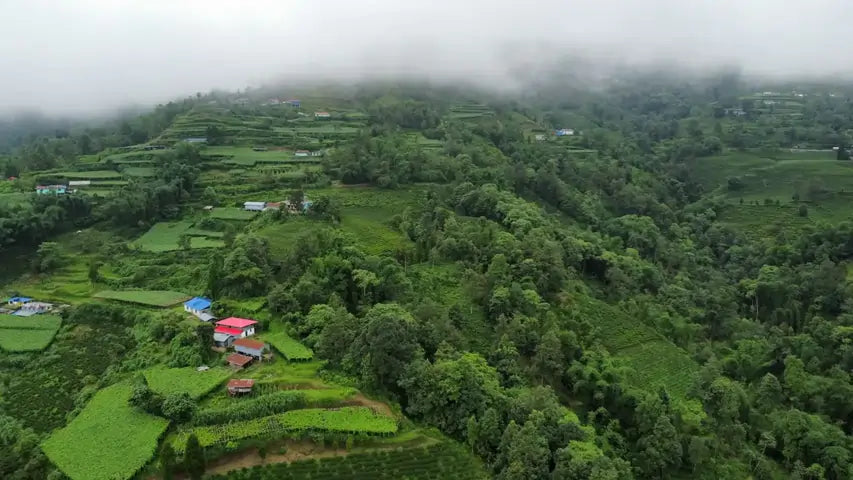
Picture this: a cup of tea so fragrant that it stops you mid-sip. Notes of wildflower honey, ripe stone fruit, and a clean mountain sweetness that lingers long after the last drop. You might assume it came from one of the famous Darjeeling estates. More likely, it grew a hundred kilometres north — in Nepal, at 6,000 feet, on a hillside so steep the farmers call it the “staircase to the clouds.”
Nepal tea is, quietly, one of the world’s great undiscovered pleasures. Connoisseurs in Japan, Germany, and Australia have known it for a decade. Canada is just starting to catch up. This guide explains exactly why that is, what makes Nepali tea extraordinary, how it honestly compares to Darjeeling, and — if you decide you’re ready — which teas to start with.
New to Nepal tea? The fastest way in is our Tea Sampler Kit ($30) — 10 single-origin teas from 4 farms, covering black, oolong, green, and white. It was built exactly for this moment.
1. Why Nepal Tea Is Still “Hidden” Despite Being World-Class
Tea has grown in Nepal since 1863 — roughly the same era that Darjeeling’s colonial-era estates were being planted across the border. The two regions share nearly identical terroir: the same Himalayan foothills, the same misty monsoon seasons, the same ancient cultivars of Camellia sinensis. Yet Darjeeling became globally famous while Nepal remained a footnote. Why?
Three reasons, and they’re all structural rather than about quality:
- Colonial marketing infrastructure. British planters in Darjeeling built auction houses, export networks, and brand identity over 150+ years. Nepal had no equivalent system until well into the 20th century.
- Geographic isolation. Nepal’s best tea districts — Ilam, Taplejung, Panchthar — are remote. Roads connecting those highlands to Kathmandu and export ports were only built in recent decades.
- The blending shadow. For years, Nepali tea has been exported to India and sold — blended, unlabelled — as Darjeeling. Nepal’s exceptional quality was propping up someone else’s brand. That’s changing, but slowly.
Nepal’s specialty tea industry only gained serious international traction around 2010, when a handful of artisan estates began direct-exporting to quality-conscious buyers in Europe and Japan. What those buyers found surprised them: teas that matched — and sometimes exceeded — the best of Darjeeling, at a fraction of the price, with complete traceability.
2. The Geography of Nepali Tea: Why Altitude Changes Everything
Nepal produces specialty tea primarily in its eastern highlands, a ridgeline of steep valleys and mist-wrapped summits running roughly from Ilam district in the south to Taplejung in the far northeast. These are not merely “hills.” This is Himalayan terrain — dramatic, cold at night, perpetually humid from the monsoon, and bathed in intense high-altitude UV light.
Ilam District (1,200–2,100m / ~4,000–6,900ft)
Ilam is Nepal’s tea heartland, producing over 70% of the country’s specialty orthodox tea. The district spans a wide range of elevations, which means a diversity of flavour profiles within a single region. Lower gardens yield fuller-bodied, maltier blacks. Mid-elevation gardens produce the classic Ilam profile — bright, floral, honey-toned. High-elevation Ilam gardens above 1,800m begin to express a pronounced muscatel character: that distinctive grape-and-honey sweetness associated with Darjeeling’s prized second flush.
Why does altitude matter so much? At high elevation, cooler temperatures slow the growth of the tea plant significantly — sometimes by half compared to lowland growing. That slower growth concentrates aromatic compounds in the leaf. The result is more complexity per gram, more natural sweetness, less bitterness. It’s the same reason mountain fruit tends to be smaller but more intensely flavoured than lowland fruit.
Taplejung District (1,800m+ / ~6,000ft+)
Nepal’s northeastern frontier is wilder, less accessible, and produces some of the country’s rarest tea. Taplejung gardens sit consistently above 6,000 feet — higher on average than most Ilam farms — with an alpine climate that brings sharper cold nights and lower annual temperatures. The teas that emerge tend to be deeper, more mineral, with a lingering complexity that tea drinkers describe as “mountain air in a cup.”
Our Special Black Tea ($11/25g) comes from Taplejung’s 6,000ft producers and is genuinely one of the rarest teas in our range.
3. Nepal Tea vs. Darjeeling: The Honest Comparison
Let’s have the conversation that most tea guides avoid. Darjeeling is legitimately excellent — but the Darjeeling market has a transparency problem that Nepal does not.
| Factor | Darjeeling Tea | Nepal Tea (Nepal Hills) |
|---|---|---|
| Terroir | Himalayan foothills, 600–2,100m, similar cultivars | Himalayan foothills, 1,200–2,100m+, same cultivars |
| Flavour character | Floral, muscatel, sometimes astringent at lower grades | Floral, muscatel, honey, stone fruit — often softer finish |
| Traceability | Variable — significant blending with Nepali/other teas occurs | 100% traceable, single-origin, named farms |
| The labelling issue | ~50M kg “Darjeeling” sold globally vs. ~8.5M kg produced | What it says on the packet is what’s in the packet |
| Price point | Premium GI-protected branding often inflates price beyond quality | Better value — quality without the brand tax |
| Availability in Canada | Widely available but heavily blended at retail level | Specialty — Nepal Hills ships direct within Canada |
The blending issue deserves emphasis. India produces roughly 8.5 million kilograms of genuine Darjeeling tea per year. Yet approximately 50 million kilograms of tea labelled “Darjeeling” enters global markets annually. That gap has to come from somewhere — and a large portion is Nepali tea, imported into India and blended before export. The Darjeeling tea you’ve been buying from a supermarket almost certainly contains Nepali tea. The irony? It probably tastes better because of it.
When you buy Nepal Hills, you are buying the actual source — not the blend. The farm name, the district, the flush season: it’s all there.
4. The Types of Tea Nepal Produces: A Flavour Map
Black Tea
Nepal’s black teas are orthodox whole-leaf — not CTC (crush-tear-curl), the industrial method used for mass-market teabags. Expect flavour notes ranging from dark honey and ripe mango (lower elevation, lush and sweet) through to wild cherry, cocoa, and stone fruit at higher elevations. The muscatel character — that distinctive grape-like sweetness — appears naturally in high-altitude second-flush Nepali black teas.
Oolong Tea
Oolong is partly oxidised — somewhere between green and black — and Nepal makes it unusually well. The altitude-driven aromatics that make Nepali black teas shine are even more pronounced in oolong, because the partial oxidation amplifies floral and stone-fruit notes.
Green Tea
High-altitude Nepali green teas are a revelation for anyone who has only experienced bitter, overly grassy greens from mass-market brands. The cool growing conditions and careful processing produce a cup that is light, sweet, and genuinely approachable.
White Tea
White tea is the least processed of all tea types. Nepal’s high-altitude white teas are extraordinarily delicate: think spring blossom, morning dew, a faint natural sweetness, and a velvety texture that feels almost impossibly gentle.
5. Where to Start: A Buyer’s Guide by Flavour Preference
Best starting point for almost everyone: The Tea Sampler Kit ($30) includes 10 teas from 4 farms and covers every style. If you’ve never tried Nepali tea — or want to give someone an introduction to it — this is the one.
If you love a rich, warming black tea
- Gold Black Tea — $20/50g — Honey, mango, natural sweetness. Full-bodied but smooth. A great daily drinker for anyone who normally reaches for Assam or English Breakfast.
- Ruby Black Tea — $10/25g — Cherry, cocoa, bold yet smooth. The most structured tea in the range.
- Black Tea Lover Pack — $47.40 — Four black teas in one pack. Best value if you already know you love black tea.
If you love floral, honey, muscatel character (Darjeeling fans)
- Muscatel Black Tea — $10/25g — Honey, wild grape, floral lift. The direct answer to Darjeeling second flush — same muscatel character, traceable origin, no blending.
- Special Black Tea — $11/25g — Taplejung, 6,000ft altitude. Deep, mineral, complex.
- Floral Oolong — $10/25g — Honey blossom, light and bright.
If you love oolong or roasted teas
- Dark Oolong — $10/25g — Stone fruit, roasted warmth, amber cup.
- Floral Oolong — $10/25g — Lighter oxidation, more floral and sweet. Delicious chilled as well as hot.
If you love light, delicate teas (green or white)
- Floral Green Tea — $10/25g — Light, sweet, genuinely no bitterness. The kind of green tea that converts people who thought they didn’t like green tea.
- Floral White Tea — $10/25g — Spring blossom, velvety texture.
- Fresh White Tea — $10/25g — Pure, dew-kissed, almost ethereal.
Best gift or variety starter
- Welcome Pack — $46.48 — Three teas across styles — a thoughtful introduction.
- Tea Sampler Kit — $30 — Ten teas, four farms. The definitive sampler.
6. How to Brew Nepal Tea: A Practical Guide
The main mistake people make is brewing with boiling water or steeping too long. Both flatten the flavour and can introduce bitterness.
| Tea Type | Water Temp | Leaf: Water Ratio | First Steep | Re-steep? |
|---|---|---|---|---|
| Black Tea | 90–95°C | 2–3g per 200ml | 2–3 minutes | Yes — 2nd steep, 3.5 min |
| Oolong (Dark) | 90–95°C | 3g per 200ml | 2 minutes | Yes — 2nd and 3rd steep |
| Oolong (Floral) | 85–90°C | 2–3g per 200ml | 1.5–2 minutes | Yes — excellent 2nd steep |
| Green Tea | 75–80°C | 2g per 200ml | 1.5–2 minutes | Yes — 2nd steep, slightly longer |
| White Tea | 75–80°C | 3g per 200ml | 2–3 minutes | Yes — often best on 2nd steep |
7. Frequently Asked Questions About Nepal Tea
What does Nepal tea taste like?
It varies by style and altitude, but Nepali specialty teas generally share a few qualities: natural sweetness, floral and fruit-forward aromatics, and a smooth, clean finish with minimal bitterness. Black teas from Nepal tend toward honey, mango, stone fruit, and muscatel notes. Oolongs lean floral or roasted depending on oxidation. Greens are light and sweet. Whites are delicate and velvety.
Is Nepal tea the same as Darjeeling tea?
They share the same Himalayan terroir, the same cultivars, and very similar flavour profiles — especially in the muscatel-forward styles. The key differences are traceability and marketing. A significant portion of tea sold as “Darjeeling” in global markets is actually blended with Nepali tea. Nepal Hills teas are 100% single-origin and named by farm — you know exactly what you’re getting and where it came from.
Where can I buy Nepal tea in Canada?
Nepal Hills Tea (nepalhillstea.ca) is a Canadian company that sources directly from artisan farms in Nepal’s Ilam and Taplejung districts and ships within Canada. The Tea Sampler Kit ($30) is the best starting point. Individual teas start at $10/25g.
What is first flush Nepal tea?
The first flush is the first harvest of the year, typically beginning in late March and running through April. These are the youngest, most tender leaves after the tea plants’ winter dormancy. First flush teas tend to be lighter in colour, more delicate in flavour, and high in aromatic complexity — prized by enthusiasts and commanding premium pricing due to small yield.
What makes high-altitude tea better?
At elevations above 4,000–6,000 feet, lower temperatures slow the growth of the tea plant. Slower growth means the leaf has more time to accumulate aromatic compounds. The result is a more complex, naturally sweeter cup with deeper flavour per gram of leaf. High altitude also means greater diurnal temperature variation — warm days, cold nights — which further stresses the plant into producing more flavour compounds.
How should I store Nepal tea?
Store loose-leaf Nepal tea in an airtight container away from direct light, heat, and strong odours. A sealed tin or dark glass jar in a kitchen cupboard works well. Avoid the fridge — moisture and odour transfer are real problems. Black teas keep for 12–18 months; greens and whites are best within 6–12 months.
The Bottom Line
Nepal tea is not a compromise, a backup, or a Darjeeling substitute. It is its own thing — a world-class category of Himalayan tea with a growing global reputation, complete farm-level traceability, and a flavour range that runs from the most delicate spring white tea to rich, complex black teas that hold their own against anything grown anywhere.
For Canadian tea drinkers, it also represents a genuine discovery: a direct relationship with artisan farmers at high altitude, without paying the brand premium of a famous GI name, and without wondering whether what’s in the packet is actually what it says on the label.
The best way to understand Nepal tea is to taste it. Start with the Tea Sampler Kit — $30 → — 10 single-origin Nepali teas from 4 farms. Ships within Canada.